
Why Las Vegas Pools Get Calcium Buildup and What You Can Do About It
By Tonya and Jeff Clinton, Co-Owners of Vista Pools
At Vista Pools, we spend every week looking at what Las Vegas water and weather actually do to swimming pools. Jeff oversees our field operations and brings the technical perspective to our guides, while Tonya shapes the research and translates what we see into practical information for homeowners.
For this guide, we combined what we see servicing pools across the Las Vegas Valley with current guidance from local water authorities and established pool industry standards.
If you own a pool in Las Vegas, calcium buildup is not necessarily a sign that your pool has been neglected.
It is largely a consequence of where we live.
Southern Nevada has very hard water, intense sun and significant evaporation. Water leaves your pool. The minerals dissolved in that water do not. Fresh water comes back in through the autofill or garden hose, bringing another supply of minerals with it.
Over time, that cycle can leave the familiar white line around your tile, buildup around spa spillovers and water features, deposits inside equipment and water that becomes increasingly difficult to manage.
The goal is not to somehow eliminate calcium from a Las Vegas pool.
The goal is to understand it, manage it and know when it is time to take action.
Why is calcium such a problem in Las Vegas pools?
It starts with our water.
Water is considered hard when it contains high levels of dissolved minerals, primarily calcium and magnesium. The Las Vegas Valley Water District reports water hardness of 291 parts per million. The Southern Nevada Water Authority reports approximately 280 PPM, while the City of Henderson reports typical hardness around 304 PPM.
The exact number varies by water provider and source, but the message is the same: Southern Nevada starts with very hard water.
One important distinction is that these municipal numbers represent total water hardness, which includes calcium and magnesium. They should not be confused with the calcium hardness reading from a swimming pool water test.
Still, they tell us something important about the water we are continually adding to our pools.
And then Las Vegas adds another ingredient: evaporation.
The Las Vegas evaporation cycle
Here is the simplest way to understand what happens:
Water evaporates. Minerals stay. Fresh hard water enters the pool. That water eventually evaporates too. More minerals stay behind.
Repeat that process thousands of times.
Most homeowners never see how much water their pool is losing because the autofill quietly replaces it.
The Southern Nevada Water Authority estimates that an average in-ground pool loses about 48.6 gallons of water per square foot of surface area each year to evaporation. For a typical Southern Nevada residential pool of around 470 square feet, that can mean as much as 22,842 gallons of water lost to evaporation in a year.
That is a tremendous amount of water leaving the pool and being replaced.
And while the water evaporates, calcium and other dissolved minerals remain behind.
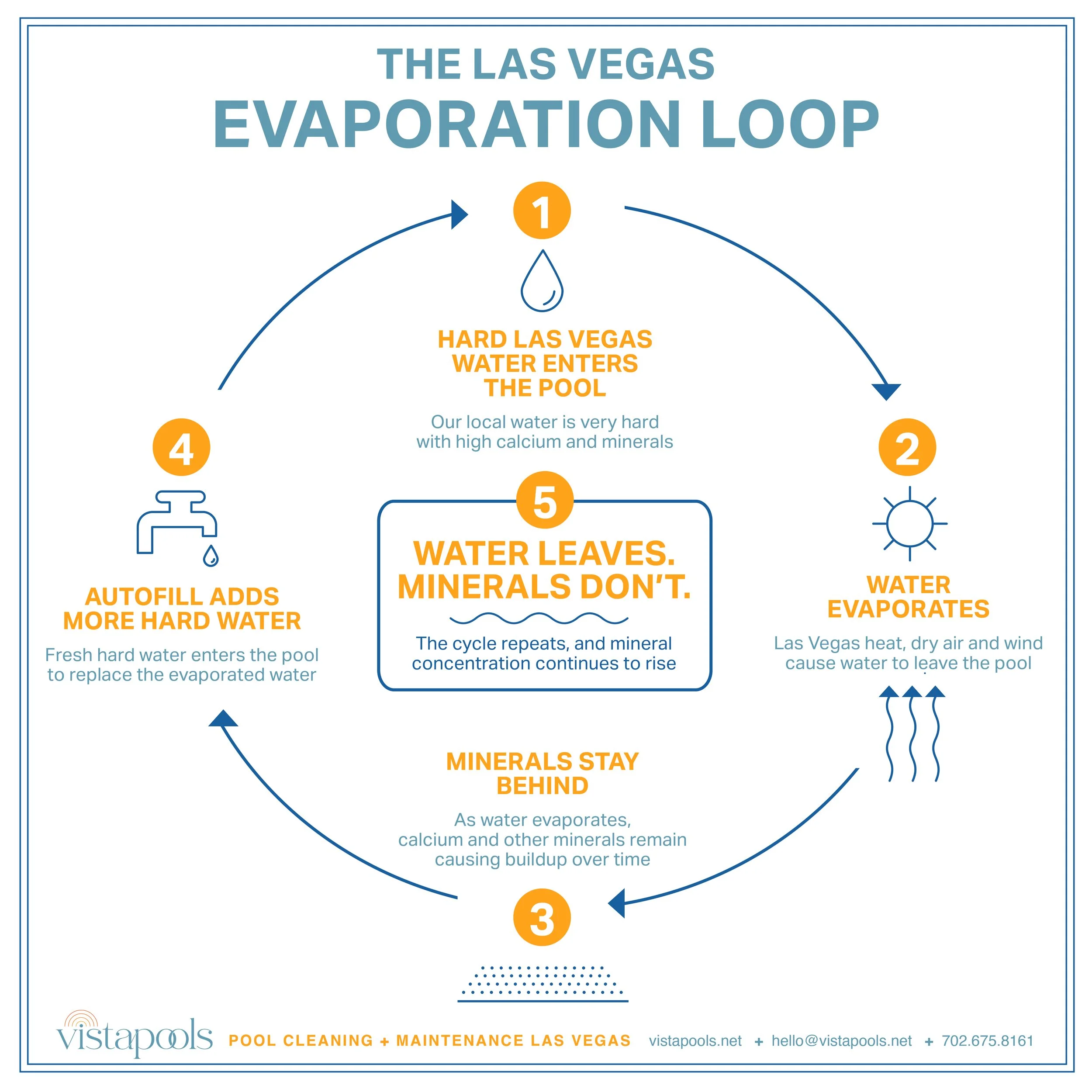
VISTA FIELD NOTE | EVAPORATION IS DIFFERENT IN EVERY BACKYARD
One thing we see again and again is that two pools can behave very differently.
A pool exposed to direct sun and wind throughout the day may lose water faster than a pool shaded for part of the afternoon. Water features and spa spillovers add another variable because they continually expose more water to air.
So while evaporation is an issue across the Las Vegas Valley, there is no single evaporation number that applies to every backyard.
Why does calcium show up as a white line on pool tile?
High calcium hardness itself is invisible.
You cannot look into a glass of pool water and see the calcium floating around.
What homeowners usually notice is what happens when mineral rich pool water reaches a surface and the water disappears.
Water splashes onto the tile. The water evaporates. The minerals remain.
Do that repeatedly and the residue begins to accumulate.
In the field, calcium buildup is pretty easy to recognize. It often looks like dried salt.
That is why buildup is particularly common:
Along the waterline
Around spa spillovers
Where water features splash onto surrounding surfaces
On raised walls near moving water
Around small equipment leaks where water repeatedly dries
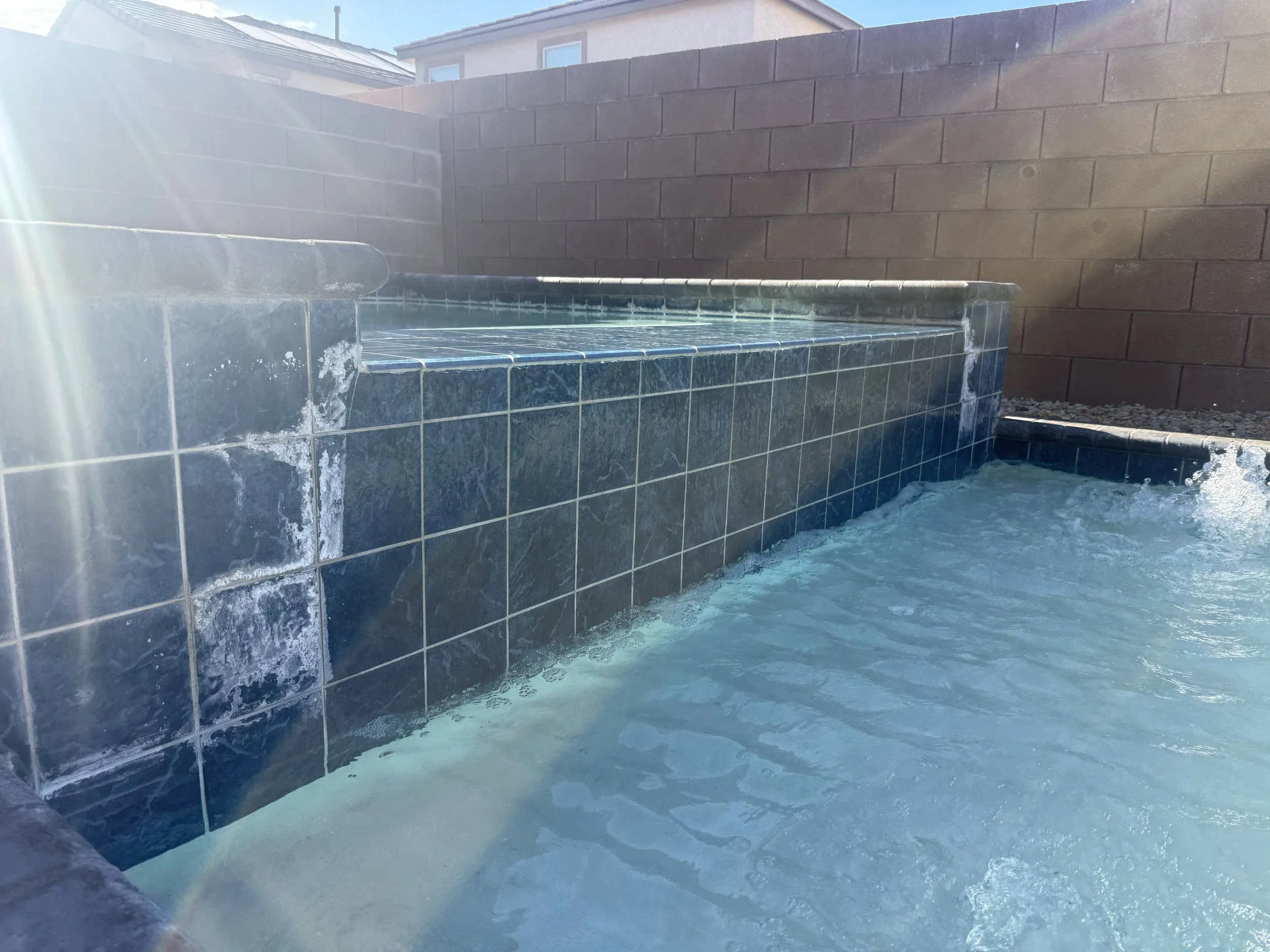
Calcium buildup around a Las Vegas spa spillover. Repeated splashing and evaporation leave minerals behind on the surface.
VISTA FIELD NOTE | LOOK AT THE SPA SPILLOVER
One of the first places we often notice calcium buildup is around a spa spillover.
Water is continually moving across the surface, splashing onto surrounding tile and evaporating. The white residue left behind can become obvious there before a homeowner notices buildup elsewhere.
Once we see it around the spillover, we know to look more closely at the waterline too. Calcium can be harder to see on tile while it is wet.
Is the white line around my pool caused by poor brushing?
This is one of the most common misunderstandings we encounter.
Regular brushing is an important part of maintaining a pool. It helps keep surfaces clean, disrupts algae and removes debris.
But brushing alone cannot stop mineral scale from forming.
Once calcium carbonate has hardened onto tile, running a normal pool brush over it is very different from removing dirt or algae.
The basic chemistry is happening independently of whether someone brushed the tile that week.
Water reaches the surface. Water evaporates. Mineral residue remains.
That is why a white calcium line can develop on an otherwise clean, properly maintained pool.
Can I remove calcium buildup myself?
Catching buildup early helps.
For appropriate pool tile surfaces, a pool stone or pumice stone may help remove light, early deposits before they become thick.
But this is one area where more pressure is not necessarily better.
Tile, grout and decorative finishes vary. An abrasive product that is safe on one surface can scratch or damage another. Always make sure the cleaning method is appropriate for your particular finish before you start scrubbing.
Once scale becomes substantial, professional tile cleaning is usually more practical and reduces the risk of damaging the finish.
What calcium hardness number should a Las Vegas pool have?
This is where generic pool advice and real world Las Vegas pool ownership can start to diverge.
The Pool & Hot Tub Alliance lists 200 to 400 PPM as the ideal calcium hardness range, with a broader permissible range depending on pool type and overall water balance.
That does not mean your Las Vegas pool suddenly becomes unhealthy or damaged the moment calcium crosses 400 PPM.
Water chemistry works as a system.
Calcium hardness interacts with:
pH
Total alkalinity
Water temperature
Total dissolved solids
Cyanuric acid
Other dissolved material in the water
This is why we do not reduce the condition of a pool to a single number.
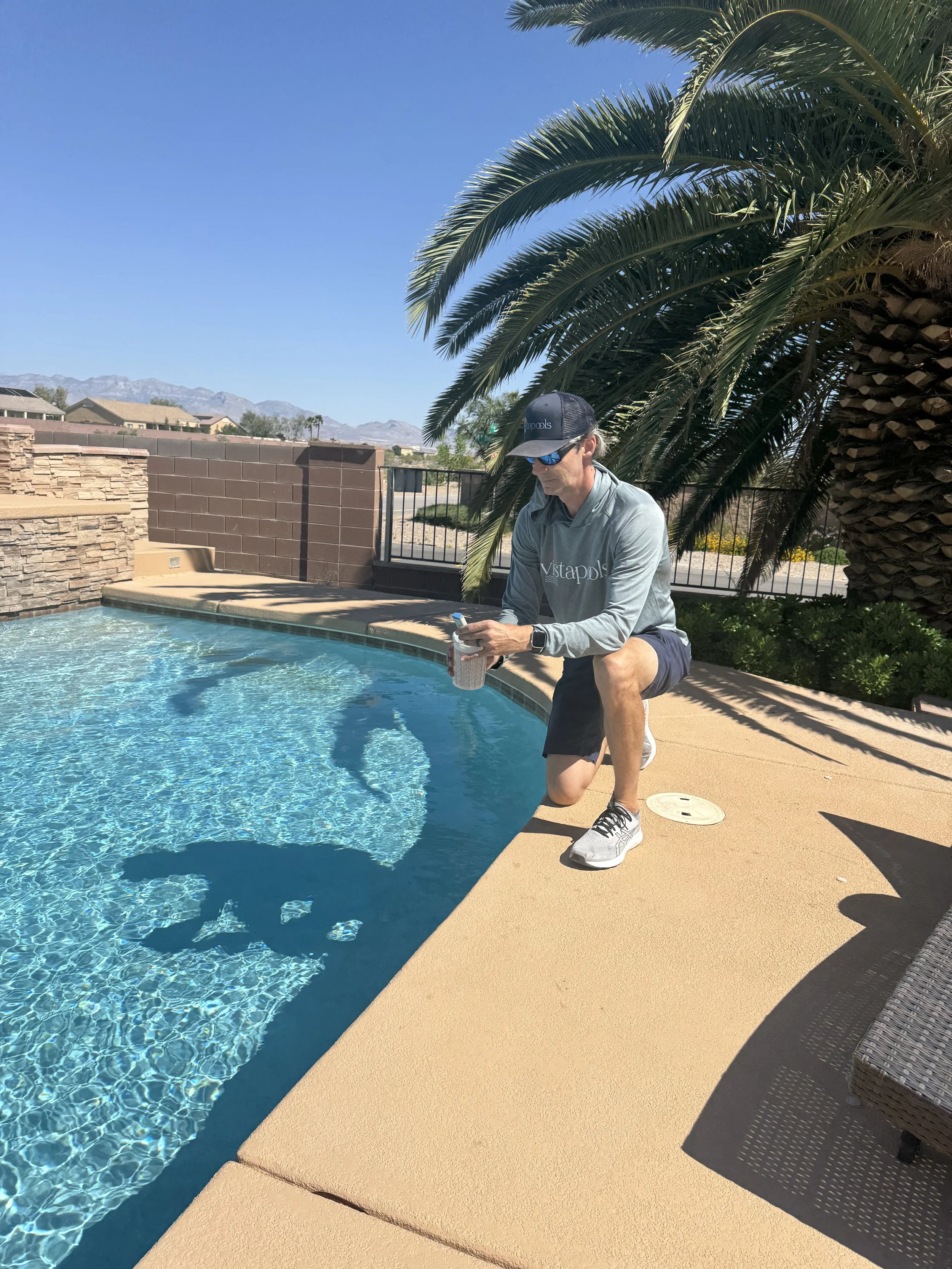
VISTA FIELD NOTE | THE NUMBER MATTERS, BUT IT IS NOT THE WHOLE STORY
A calcium hardness reading around 400 PPM would not automatically make us recommend draining a Las Vegas pool.
We look at the entire picture.
As calcium climbs, we also look at the age of the water, CYA, TDS, overall water balance and how difficult the pool has become to maintain. When several of those factors are moving in the wrong direction, water replacement starts to make much more sense.
The number matters. The condition of the water matters more.
What is LSI and why does it matter?
Pool professionals often use the Langelier Saturation Index, usually called LSI, to evaluate whether water is more likely to deposit calcium carbonate scale or become aggressive toward calcium containing surfaces.
You do not need to learn the formula to own a pool.
What matters is this:
A calcium reading by itself does not tell the whole story.
The balance between calcium hardness, pH, alkalinity, temperature and total dissolved solids influences whether calcium tends to remain in the water or form scale. PHTA guidance also cautions that LSI is a predictive tool, not an absolute determination of what will happen in a particular pool.
When calcium hardness is elevated, other water balance factors may sometimes be managed within appropriate ranges to help offset its effect. Pushing those numbers too low is not the answer either because overly aggressive water creates a different set of problems.
That distinction matters in Las Vegas.
We are not trying to force hard desert water into an unrealistic textbook number at any cost. We are trying to maintain balanced, sanitary water while limiting scale as much as reasonably possible.
Can chemicals lower calcium hardness?
Usually, no.
Some products can help control scale formation by keeping minerals in solution or interfering with the formation of deposits.
But they do not make the calcium disappear.
If the objective is to materially reduce the amount of calcium dissolved in the pool water, some of the water itself normally has to be replaced or treated.
Industry guidance identifies partial or full water replacement as a direct method of reducing calcium hardness.
This is why products promising an effortless fix for hard water deserve a little skepticism.
They may be useful tools. They are not the same thing as removing calcium from the water.
When should a Las Vegas pool be drained?
There is no universal calcium number at which every Las Vegas pool should suddenly be drained. Calcium is rarely the only reason we make that recommendation.
As pool water ages, other dissolved material can accumulate too. Cyanuric acid, often called CYA, and total dissolved solids, or TDS, can become part of the decision. TDS is a measure of the dissolved material that has accumulated in the water, including minerals, salts and other substances.
The Las Vegas Valley Water District says many local pool professionals recommend complete or partial water replacement approximately every three to five years, even with proper and regular pool maintenance.
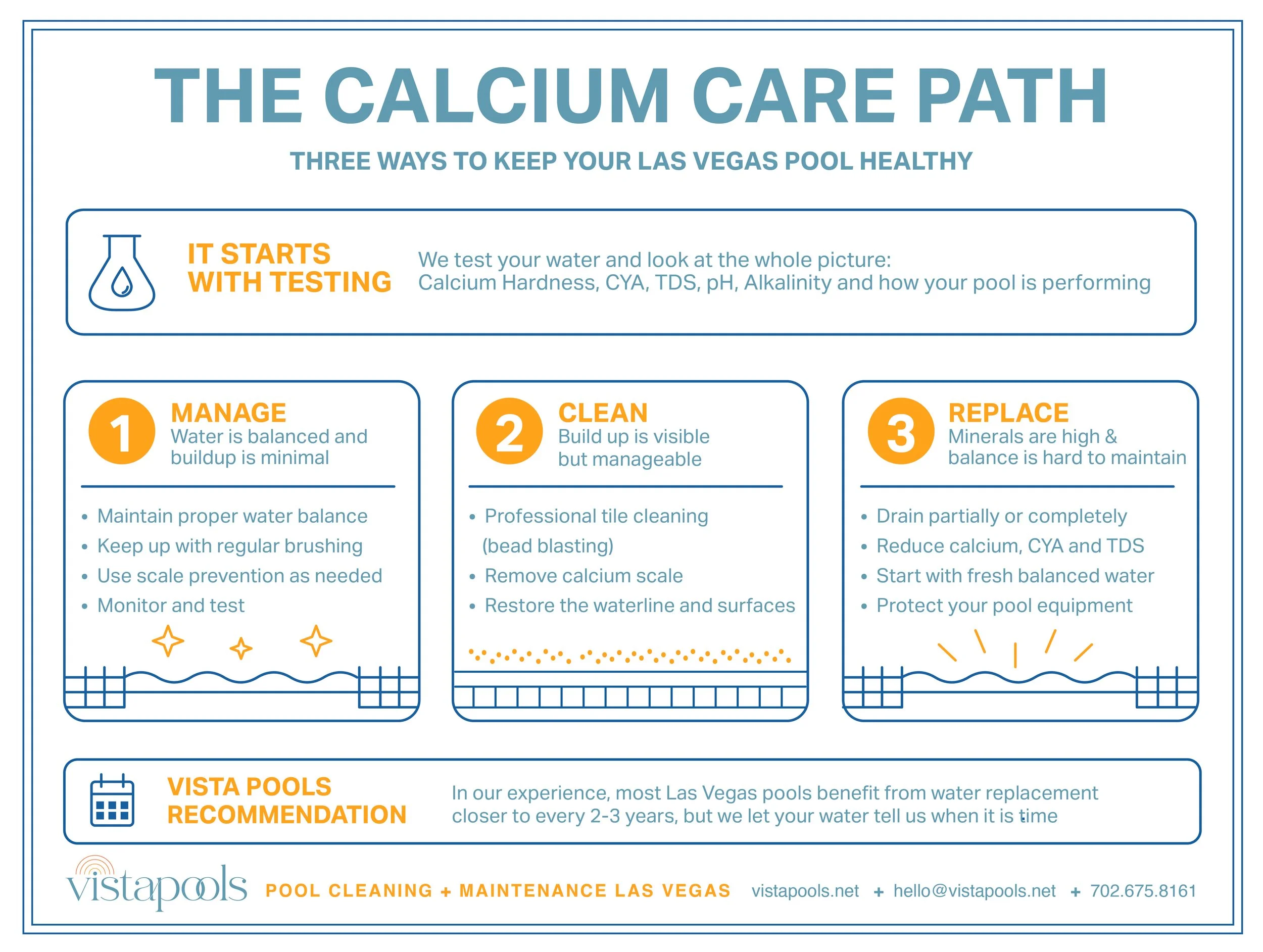
At Vista Pools, we do not put every pool on the same schedule. In our experience, many Las Vegas pools benefit from water replacement closer to every two to three years because of our hard water and the amount of evaporation we experience. But we test the water first.
We look at calcium hardness along with CYA, TDS, overall water balance and how the pool is behaving. Some pools may need fresh water sooner. Others can go longer.
The calendar gives us a reason to take a closer look. The water tells us when it is actually time.
Does high calcium cause cloudy pool water?
It can contribute, but cloudy water should not automatically be blamed on calcium.
High calcium levels can contribute to calcium carbonate precipitation and cloudiness when the overall water balance favors scale formation.
But cloudy pool water has many possible causes, including filtration issues, inadequate sanitation, algae and other chemistry problems.
So we do not look at a cloudy pool and immediately assume the calcium is high.
We test the water and look at the entire system. Calcium may be part of the problem, but filtration, sanitation, algae or another chemistry issue may be the real cause.
That is why testing matters. Treating cloudy water without knowing what is causing it can mean adding chemicals that never address the actual problem.
Can calcium damage pool equipment?
Yes, especially when scale accumulates over time.
High calcium water can create deposits inside equipment, particularly on hot surfaces in heaters and heat exchangers. Salt chlorine generator cells can also develop scale accumulation and need periodic inspection and cleaning.
But calcium around the equipment pad can tell us something else too. Sometimes it helps us spot a leak.
A fitting, seal or o-ring may be losing such a small amount of water that there is never an obvious puddle. Each little bit of water escapes and evaporates, but the minerals are left behind. Over time, that creates a white crust around the source of the leak.
VISTA FIELD NOTE | SOMETIMES CALCIUM POINTS US TO THE PROBLEM
We have found small equipment leaks because of the calcium residue they leave behind. What looks like a little white buildup around a fitting can be the clue that water is escaping.
Catching it early can mean a relatively simple repair, such as replacing a seal or o-ring, before a small leak contributes to a much larger equipment problem.
So calcium is not always the problem itself. Sometimes it is the evidence that helps us find one.
Tile cleaning and acid washing are not the same thing
These services are often confused, but they solve different problems.
Tile cleaning
Professional tile cleaning targets calcium and mineral scale attached to the waterline tile and other appropriate hard surfaces.
One common professional method is bead blasting, which uses blasting media to remove hardened calcium deposits from appropriate tile surfaces. The exact cleaning method should depend on the tile and severity of the buildup.
Bead blasting and acid washing are sometimes talked about as though they are interchangeable. They are not. Bead blasting addresses buildup on the tile. An acid wash addresses staining and discoloration on appropriate pool surfaces.
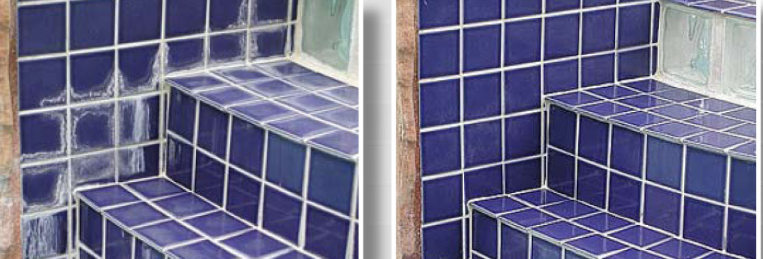
Before and after: professional tile cleaning removes hardened calcium buildup from the waterline. Work performed by Tile Savers.
Acid washing
An acid wash is primarily used to address staining and discoloration in plaster or certain pool finishes.
It is not simply another name for removing the white scale from your waterline tile.
Sometimes it makes sense to have both services performed while the pool is already drained.
The pool is emptied. The waterline scale can be professionally cleaned. The pool surface can be evaluated and treated if appropriate. Then the pool is filled with fresh water and balanced again.
One drain. Two different jobs.
What happens if you ignore calcium buildup?
Early calcium buildup is often primarily cosmetic.
That does not mean ignoring it indefinitely is the smartest financial decision.
As the deposit becomes thicker and harder, removal becomes more difficult.
We see this when tile cleaning gets postponed through multiple drain cycles. What may have been relatively manageable earlier becomes a much more significant cleaning job later.
Severe scale can also affect equipment and, in extreme cases, pool surfaces themselves.
We have encountered pools where calcium hardness was so high that getting a useful reading with a standard field test was difficult, and deposits were no longer confined to a thin line around the waterline.
That is not the typical Las Vegas pool.
It is an example of what can happen when a manageable condition is allowed to become an extreme one.
Can reverse osmosis remove calcium without draining the pool?
Yes.
Mobile reverse osmosis systems can process pool water and remove dissolved minerals and other contaminants without completely emptying the pool.
It can be an option for homeowners who want to reduce calcium hardness while conserving more of their existing water.
There are tradeoffs.
The process has a cost, some water is still lost during treatment, availability varies and whether it makes financial sense depends on the individual pool.
For most homeowners, the useful takeaway is simply that complete draining is not the only technology capable of reducing dissolved calcium.
One thing every Las Vegas pool owner should understand
If you remember only one thing from this guide, make it this:
Calcium buildup does not automatically mean someone has failed to take care of your pool.
Our source water is very hard.
Our climate evaporates an extraordinary amount of water.
The minerals stay behind.
Good pool care can manage the chemistry, slow scale formation, identify buildup early and help you decide when cleaning or water replacement makes sense.
It cannot change the chemistry of the water coming into your backyard.
That is part of owning a pool in Las Vegas.
And once you understand that, calcium becomes much less mysterious.
Frequently Asked Questions About Calcium Hardness in Las Vegas Pools
What is the ideal calcium hardness level for a pool?
For masonry pools, widely used industry guidance places the ideal calcium hardness range around 200 to 400 PPM. The acceptable operating range can be broader depending on the rest of the water chemistry. Calcium hardness should be evaluated alongside pH, alkalinity, temperature and other water balance factors.
Why does my Las Vegas pool get a white line around the tile?
The white line is often calcium carbonate scale or other mineral residue. Pool water reaches the tile, evaporates and leaves dissolved minerals behind. Repeated evaporation gradually creates the visible deposit.
Can my pool service brush calcium off every week?
Routine brushing helps keep pool surfaces clean, but established mineral scale does not behave like dirt or algae. Early deposits may sometimes be managed with appropriate tile cleaning, but hardened scale often requires specialized cleaning such as bead blasting.
Does high calcium mean I need to drain my pool?
Not automatically. Calcium hardness is only one factor. The age of the water, CYA, TDS, overall balance, visible scale and condition of the pool should all be considered before deciding whether to replace water.
Can chemicals remove calcium from pool water?
Most scale control chemicals do not actually remove the calcium. They can help control scale formation, but meaningfully lowering calcium hardness generally requires water replacement or another treatment process.
Does calcium hardness make pool water cloudy?
It can, particularly when the overall water chemistry favors calcium carbonate precipitation. But cloudy water has many possible causes, so calcium should not be assumed to be the problem without proper testing.
Why is calcium worse in Las Vegas?
Southern Nevada's municipal water is classified as very hard, and our dry climate causes substantial evaporation. The combination means pools continually receive mineral rich replacement water while evaporation leaves dissolved minerals behind.
How often should a Las Vegas pool be drained?
There is no schedule that fits every pool. The Las Vegas Valley Water District notes that many local pool professionals recommend partial or complete water replacement approximately every three to five years.
At Vista Pools, we often find that two to three years is a useful point to take a closer look at the water, but we test before recommending a drain. The correct timing depends on the actual chemistry and condition of the pool.
When you are not sure what you are looking at
If you are seeing a white waterline, cloudy water or mineral buildup around your equipment and are not sure what it means, start with testing rather than guessing.
Sometimes the answer is routine maintenance.
Sometimes the tile needs attention.
Sometimes the water has reached the point where replacement makes sense.
Knowing the difference is what good pool care is really about.
Vista Pools provides weekly residential pool service, including water chemistry management, along with specialty pool services throughout the Las Vegas Valley.
WE CLEAN. YOU ENJOY.